
Tobacco
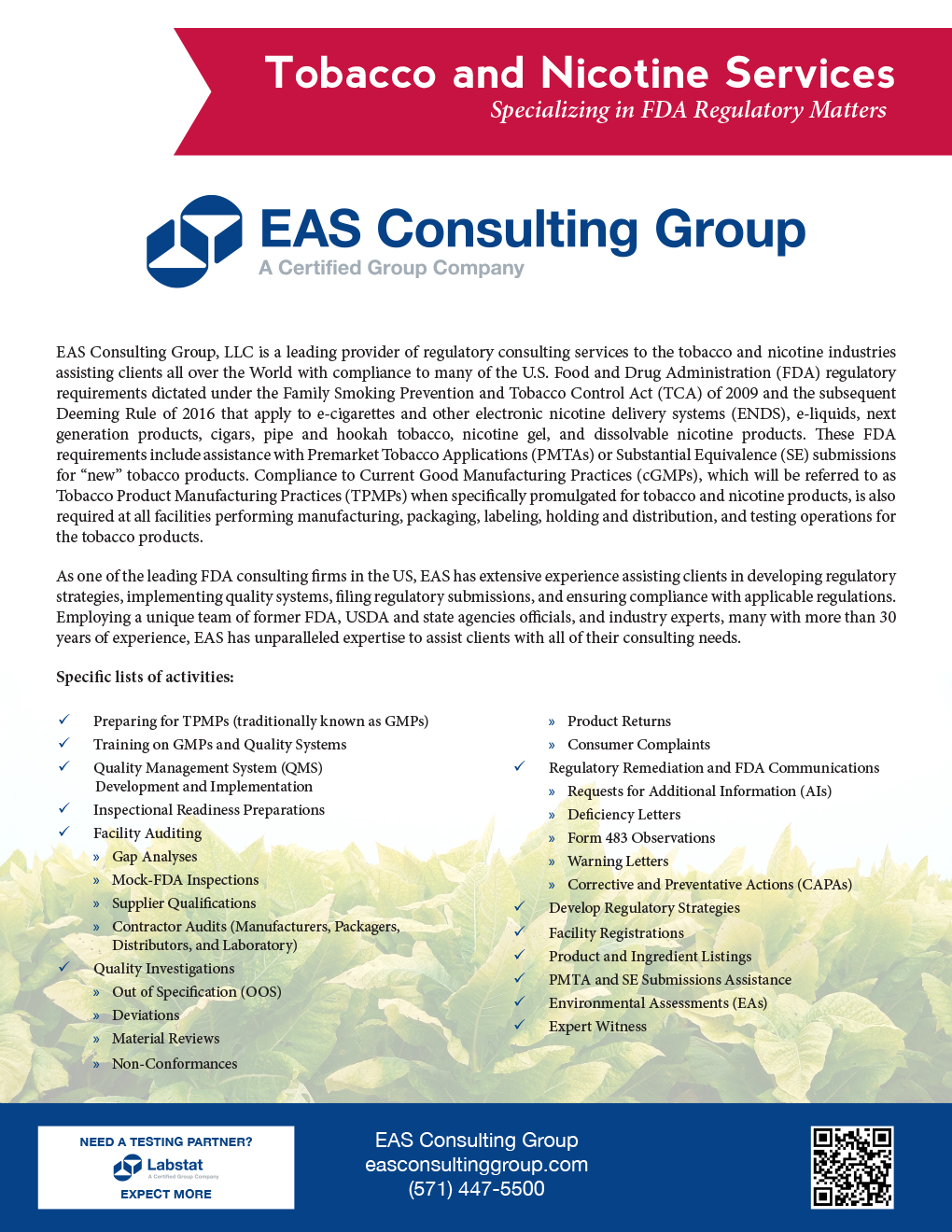
There are numerous new FDA initiatives concerning tobacco and electronic nicotine delivery system (ENDS) products. The industry is in a state of flux and you need the most reliable regulatory support in your corner. EAS is a leading consulting firm for the tobacco industry helping manufacturers and distributors maintain strict compliance with requirements of the Family Smoking Prevention and Tobacco Control Act of 2009 and the Deeming Rule.
EAS offers assistance with the development of quality systems, compliance assessments of manufacturing facilities, filing of regulatory submissions and more to ensure your facility, product and labeling meet FDA’s stringent requirements for the tobacco industry. Whether ENDS products, cigars, pipe tobacco or c-cigarettes, cigars, certain dissolvables that are not “smokeless tobacco,” gels, and waterpipe tobacco, EAS provides the expert answers you need no matter the regulatory question.
Overview of Tobacco Services
Tobacco Product Manufacturing Practices and Quality Systems
FDA is developing TPMPs which, once complete, will be the new standard by which all tobacco firms must comply. EAS is regularly called upon to review tobacco manufacturing procedures and quality systems for both large and small facilities. We provide guidance on implementing FDA recognized quality systems, including preparation or reviews of standard operating procedures (SOP) and how to maintain compliance standards for tar and nicotine. We help firms prepare for FDA mandated biannual facility inspections through mock-FDA audits and support during audits or inspections by FDA.

Tobacco Registration and Submissions Assistance
EAS assists tobacco firms with FDA submissions, applications and annual registrations of products and facilities for new tobacco products as well as products with modified risk claims. Additionally, we facilitate annual registrations, Premarket Tobacco Applications (PMTA) and marketing Orders for Modified Risk Tobacco Applications (MRTP). We also assist with Substantial Equivalence Submissions (SE).

Facility Compliance Audits
EAS Independent Consultants provide compliance assessments and mock FDA-inspection services, providing detailed analysis and reports on how your systems and procedures align with current FDA expectations and what corrective actions and enhancements you may want to consider in preparation for future TPMP requirements. Our detailed facility audits include a thorough report and recommendations for any Gaps identified. We also provide contractor audits of manufacturers, packagers, distributors and laboratories.
Tobacco Label and Market Reviews
EAS reviews tobacco product labels for compliance with required FDA information as well as filing of proper FDA marketing orders. We ensure disclosure information on ingredients and constituents of tobacco products is in order and provide recommendations for compliance with the FDA Enforcement Action Plan for advertising and promotion restrictions per the Tobacco Control Act Requirements.
Related News
Dean Cirotta Featured in Tobacco Reporter on FDA’s Proposed Foreign Tobacco Manufacturer Registration Rule
FDA Proposes Rule to Strengthen Accountability for Foreign Tobacco Product Manufacturers
FDA Issues Guidance on Enforcement Priorities for Unauthorized ENDS and Nicotine Pouch Products
FDA Highlights Importance of Confidential Information in Maintaining Regulatory Integrity
FDA Launches Web-Based Tobacco Premarket Application Forms to Enhance Submission Process
Transition from Computer System Validation (CSV) to Computer Software Assurance (CSA)
The life science industries, including pharmaceutical, medical device, biotechnology, biological, and tobacco and tobacco-related products continue to embrace new technology to improve delivery of quality products in compliance with FDA. In addition, we’ve seen a trend toward making use of cloud services, Software-as-a-Service (SaaS) solutions, and other technical innovations such as use of Artificial Intelligence (AI), Machine Learning (ML) and Large Language Models (LLMs), such as ChatGPT that have more recently begun to be used more heavily in life science companies.
21 CFR Part 11 (Electronic Records & Signatures) Compliance for Computer Systems Regulated by FDA
The Webinar will focus on the importance of ensuring that electronic record/electronic signature (ER/ES) capability built into FDA-regulated, or “GxP” computer systems meets compliance with 21 CFR Part 11. This includes development of a company philosophy and approach, and incorporating it into the overall computer system validation program and plans for individual systems that have this capability.
FDA’s 21 CFR Part 11 was enacted in 1997 and implementation success across the pharmaceutical and other regulated industries has been mixed. There are very specific limitations that arise when using ER/ES capability, such as the elimination of print capability to prevent users from making decisions based on a paper record as opposed to the electronic, or system of record.
Validation & Use of FDA-Regulated Systems Using AI, ML & Large Language Models (LLMs), such as ChatGPT
The life science industries, including pharmaceutical, medical device, biotechnology, biological, and tobacco and tobacco-related products continue to embrace new technology to improve delivery of quality products in compliance with FDA. In addition, we’ve seen some trends toward making use of cloud services, Software-as-a-Service (SaaS) solutions, and other technical innovations that have more recently begun to be used more heavily in life science companies.
Artificial Intelligence (AI), Machine Learning (ML) and Large Language Models (LLMs), such as ChatGPT are beginning to find a presence at these companies. While life science companies tend to lag behind other markets in using these technologies, they are catching up and we are seeing much more activity related to AI use in software applications used to develop, produce, test, and manage life science products with quality and compliance.
As the pace of technological innovation and evolution becomes more intense, there is a critical need for computer system validation, 21 CFR Part 11 (Electronic Records and Electronic Signatures) compliance, and data integrity assurance to continue in environments where artificial intelligence (AI) and machine learning (ML) are becoming prevalent.
FDA became alarmed by the lack of compliance to meet data integrity and Part 11 requirements during the last decade. Out of compliance citations during this period, including Form 483s and Warning Letters have skyrocketed for these key areas of compliance. But why?
Based on discussions with clients and stakeholders at conferences and meetings, it has become more and more obvious that most of the performers in industry are under management pressure to do more work with fewer resources and in less time. This continues to lead performers to seek faster and easier ways to get the work done, and opens the door to more conversation around the use of AI/ML in software development, testing, and support.
Data Integrity and Governance for Computer Systems Regulated by FDA
During this webinar, we will focus on the importance of ensuring that both structured (e.g., database records) and unstructured (e.g., Word document, PDF, spreadsheet) data are maintained with integrity through their chronological life cycle. This requires recognition that FDA is laser-focused on data integrity issues based on industry inspection trends during the past decade.
FDA’s Guidance for Data Integrity, issued in December 2018, did not include a single new requirement. Instead, it reiterated parts of the Code of Federal Regulations (CFRs) that have been in place for decades, and which industry was failing to meet.
Emerging FDA Trends in Computer System Validation (CSV)
The life science industries, including pharmaceutical, medical device, biotechnology, biological, tobacco and tobacco-related products continue to embrace new technology to improve delivery of quality products in compliance with FDA.
We have seen the recent trend in industry toward using cloud-based services, Software-as-a-Service (SaaS) solutions, and other technical innovations. More recently, we have begun to see newer, emerging technologies including Artificial Intelligence (AI), Machine Learning (ML) algorithms & Large Language Models (LLMs), such as ChatGPT begin to find a presence within these companies.
While life science companies tend to lag behind other markets in using these technologies, they are catching up and we are seeing much greater use of AI in the development, testing, release & management of life science products with quality and compliance. This is most predominant in the medical device industry, where we find both medical devices that include software as a product component & Software-as-a-Medical-Device (SaMD) products that function as a medical device without the need for any hardware.
Related Resources

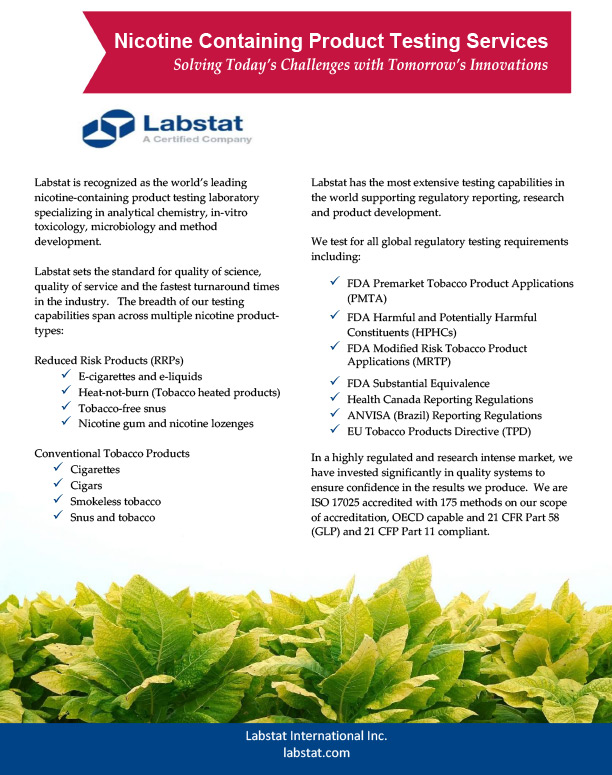
Your Best in Class Testing Laboratory for Tobacco and ENDS Products
Labstat is the largest independent third-party testing company of nicotine containing products in the world. Supporting regulatory testing and research for e-cigarette liquids, vapours, cigarettes (mainstream and sidestream tobacco smoke), whole tobacco, snus and smokeless tobacco, Labstat is ISO 17025:2005 accredited and GLP (Good Laboratory Practices) compliant and offers an extensive scope of services including Analytical Chemistry, Toxicology and Method Development.
Need Regulatory Support?
Start the Conversation Today